
Beyond Manual Rounds: NB-IoT Monitoring for Taiwan Orchid Greenhouses
Spend less time travelling between greenhouses and re-entering readings. NB-IoT brings each site's temperature and humidity together, helping managers prioritize visits from the trends.
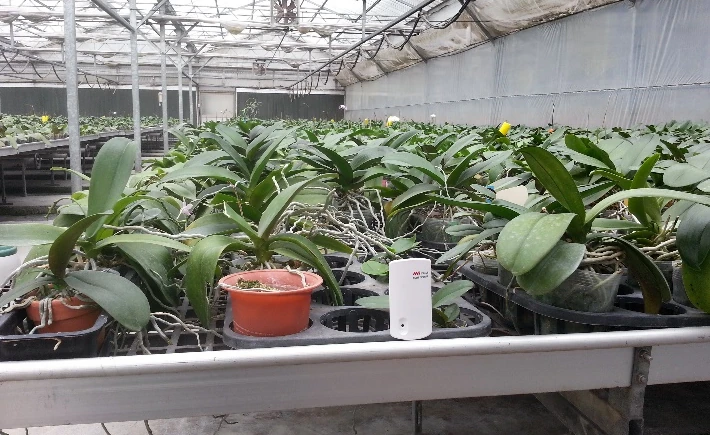
NHR orchid-greenhouse monitoring reference photo. It is not a site record of the project described here and does not establish its connectivity configuration.
Project Profile
- Region: Taiwan
- Setting: Distributed orchid greenhouses
- Measured variables: Air temperature and humidity
- Core architecture: NB-IoT wireless sensing, remote management platform, historical trend comparison
Confirmed Deployment Highlights
- Centralized multi-site view — Environmental data from separate growing sites in one interface
- Live and historical records — Current checks and cross-period comparison
- Less duplicate work — Lower dependence on repeated site visits, handwritten readings, and later re-entry
Case Snapshot
When orchid greenhouses are spread across separate locations, environmental management involves much more than taking an occasional temperature reading. Managers travel between sites, inspect each area, record observations, and enter the same information into a system before they can form a complete picture. The more time absorbed by travel and repetitive data handling, the less attention remains for the locations that actually need intervention.
This deployment, publicly documented in 2019, placed temperature and humidity sensing at the growing sites and used NB-IoT to deliver readings to a remote platform. Managers could review current conditions and historical changes before prioritizing field visits, shifting daily operations from fixed site-to-site rounds toward data-informed inspection.
The Challenge
Distributed Sites Turn Routine Checks into Fragmented Information
A manual workflow typically has three stages: visit the greenhouse, record a reading, and enter it into a system later. Because each location is checked at a different time, the resulting data becomes a set of disconnected snapshots rather than a comparable view of all sites.
For orchids that depend on controlled growing conditions, travel time is only part of the problem. Without an earlier view of which site is drifting, teams may spread limited labour evenly instead of directing attention to the greenhouse that needs it most.
The Solution
Review the Platform First, Then Send People Where They Are Needed
Temperature and humidity sensing devices at the orchid sites transmitted data over NB-IoT to a management platform. Current readings, historical records, and cross-period comparisons were consolidated so managers no longer had to complete every round before understanding the overall environmental picture.
The system did not replace horticultural expertise. It changed the order in which information reached the team: sensor data highlighted conditions worth checking, and people then handled on-site verification and crop-management action. Field rounds gained clearer priorities, while duplicate transcription was no longer required to build a useful trend record.
Operational Value
Remote Visibility Gives Multi-Site Management a Clearer Order of Work
With distributed information consolidated, managers can compare temperature and humidity changes across sites, investigate a deviation first, and schedule routine visits around higher-priority conditions. Published project material reported a reduction in labour-and-time cost, but did not disclose the baseline, measurement period, or independent validation. This page therefore does not use that percentage as a performance claim.
The confirmed change is that environmental information moved from manually assembled snapshots to records that could be viewed remotely, revisited, and compared. That directly reduced dependence on travel-only checks and repetitive data entry.
Frequently Asked Questions
What environmental data was monitored in the orchid greenhouses?
The documented scope confirms air temperature and humidity. Soil, CO₂, light, and other measurements were not established for this deployment and are not presented as project outcomes.
How did NB-IoT change greenhouse inspection rounds?
Sensor readings were delivered to a central platform, allowing managers to compare current and historical conditions before assigning field work. This reduced reliance on fixed inspection routes and manually transcribed readings.
Did the system automatically operate irrigation or greenhouse equipment?
The available evidence does not confirm automated irrigation, ventilation, heating, or other closed-loop control. The verified scope is monitoring, centralized data, and management decision support.
Which sensor model was used?
The public material does not identify a verifiable NHR model, device count, accuracy specification, or reporting interval. Product mapping should be based on the project bill of materials or acceptance record, not inferred from a current catalogue.
Next Step
For a multi-greenhouse monitoring plan, first map the number of sites, network coverage, current inspection process, and critical temperature and humidity ranges. Those inputs can then define sensor locations, NB-IoT connectivity, and the platform views operators actually need.
Explore Environmental and Agriculture Monitoring / Talk to an Expert
Notes
- Every site is different; deployment plans and outcomes should be assessed by qualified professionals against actual site conditions.